Now that it looks like like the next recession may be coming sooner rather than later, it's time to lay out what I think is clearly the best path forward for monetary policy in a liquidity trap (we should be more creative than we have been). This is an issue I've been thinking seriously since long before I worked in the Obama CEA in 2011 -- I wrote my undergraduate thesis on Japan's liquidity trap in 2003. And Japan is still in a liquidity trap. Some things never change...
Fiscal Support
My idea is simple: Fiscal Support from the Fed to the Treasury (some might call it Fiscal QE, a name I oppose, "Treasury remittances", or simply seigniorage, although I see this as slightly different). The Federal Reserve should print money, buy government bonds, and then -- crucial second step -- return those bonds to the Treasury! That's it. (Well, in fact, there are several more steps I'll discuss below, but these are the key ones...) In fact, the Fed already returns interest on the bonds it holds to Treasury. Over ten years after the first QE, in total, this has actually added up to be a substantial amount of money, and thus it is an ignored modest side-benefit of the QE program (in addition to lowering US government borrowing costs, and thus the debt).
Mechanisms
Why would this work? I can see several channels. First, smaller deficits, or even surpluses, would encourage governments to do fiscal stimulus. (How many politicians do you know who couldn't figure out a way to spend a surplus?) In fact, most countries in liquidity traps run such large deficits that after a few years, all but the most ardent keynesians/MMT people recommend fiscal austerity to counterbalance the deficits. Fiscal stimulus is likely to carry a bit more "oomph" than merely QE alone, particularly since this is a policy with an unlimited ceiling.
Secondly, this QE + fiscal transfer is likely to be more effective even if the government doesn't enact fiscal stimulus today. Why? First, it is a bit more difficult for the central bank to unwind. In addition, if the Fed just wanted a temporary stimulus, they would just go with normal QE rather than tying their hands by transferring these bonds to the Treasury. Thus, it is a signal of looser future monetary policy, and also a signal that the Fed is serious about getting the economy on track. Recall, a key problem in a liquidity trap is that the central bank needs to "credibly promise to be irresponsible" -- to convince the public that it will generate higher inflation, even after the crisis is over. What better way to do that than with "permanent QE"? One thing to note is that the central bank will still be able to raise interest rates later on, or increase reserve requirements, and so I don't think this will, in fact, inhibit the Fed from responding to inflation later on if it is so inclined, but it's a signal that the Fed believes it needs to bring in the big guns.
A third mechanism, albeit less important, is that, even if fiscal policy is non-reactive today, it will have to be reactive at some point in the future. This implies that people will, at minimum, expect to be taxed less in the future, or have government spending decreased by less.
A fourth mechanism is the classic QE mechanism: purchasing long-term bonds will lower long term interest rates mechanically. A fifth mechanism is that long-term interest rates imply a devaluation of the currency. However, in this case, I'll say full stop that these mechanisms are likely to be modest, but for good reasons -- fiscal policy can be expected to be expansionary and thus raise future interest rates.
Fiscal Support + Communication:
Were I a central banker, I would not just do this policy quietly (in which case it's likely no one would notice). I would also publicly encourage the government to engage in fiscal stimulus. I would also assure market participants that the policy will be in place and ratcheted up each month, until, at a minimum, the inflation target has been hit (even better would be to raise the inflation target, and in fact price level target, or switch to a 6% NGDP target, but this can be debated elsewhere). This is akin to telling the market you will do "whatever it takes". In fact, committing to potentially doing more at first will likely allow you to do less later on.
Alternative Options:
Of course, this is not the only policy option on the table. Short term interest rates are 1.5%. It makes sense to cut them first. However, the market is smart, and it probably realizes that the Fed only has a few arrows left in this quiver. The closer the Fed gets to zero without a credible plan for what to do next, the less effective each successive rate cut will be.
Next, the Fed could go negative. I think they should. I think this could be an effective policy particularly if the Fed subsidizes new bank loans (a la TLRTO -- the ECB's program) in addition to taxing reserves held in excess. To prevent a negative effect on total bank profits, the Fed could simultaneously provide banks with a higher positive interest rate on required reserves while taxing some smaller fraction of excess reserves over a target threshold. CBs could also tax large cash holdings of banks. I am not necessarily opposed going this route. But, I also think it will be problematic to pass along negative interest rates to depositors. I also suspect that negative interest rates, absent bank subsidies and taxes on cash holdings, could be problematic, and may be limited in how low a central bank can go (although subsidies of course are unlimited). Also, since I'm a liberal who see value in many forms of public spending, I would prefer more public spending to higher bank subsidies. (Alternatively, since I'm a capitalist who values my hard-earned money, I'd prefer receiving a tax cut to a bank subsidy.) Also, many smart economists think that negative interest rates might be contractionary. Also, are very large bank subsidies, if needed, politically feasible? I have my doubts. Still, if I were Fed Chair, I would include negative interest rates, including new loan subsidies in particular, in the arsenal. I still believe it is a crime that the Fed did not go all the way to zero in the last crisis.
The Fed can also use forward guidance. Of course they should, but talk is always cheap. If the economy and inflation recover, of course the Fed will raise interest rates, and markets know this. Also, both this policy, and plain old vanilla QE, while beneficial overall, also tend to reduce the spread between short-term and long-term interest rates. This reduces bank profits, and may make banks more likely to wait to make loans. The Fed can promise to keep interest rates zero, or at minus one, for one or two years, but can it credibly do it for 5 or 10 years? Most of the FOMC members won't even be around in five years. And the FOMC committee itself rotates every year.
This leads me to vanilla QE. Why not just do more QE? Well, yes, the Fed should. Also, after an announcement that X amount of bonds will be bought each month, if the Fed's growth and inflation targets are not met, the Fed should increase the monthly amount of bond purchases. This is what they did not do last time around, and what the BoJ has also refused to do. One argument against QE is that it was a public relations disaster. Many economists still believe it did not work. And, even though the Fed did QE last time, the economy was very slow to recover. Thus, if the Fed does merely resort to QE this time, they need to do it much more aggressively than before. They could, for example, promise to double the bond purchases every month until NGDP hits a certain target. They also would need a new way to market it. Instead of calling it just "QE", add a name that every day bond trader bros on Wall Street can relate to: "QE on steroids", or "QE on cocaine".
How about raising the inflation target too? Of course the Fed should. That the Fed continues to maintain a 2% inflation target (that it rarely even hits), now that we know what a problem the ZLB is can be thought of as a badge of incompetence. However, the problem circa 2009-2017 was that, although the Fed had an inflation target, it did not appear to have any ability to actually hit its own target. This almost certainly damaged the Fed's credibility.
Objections:
This will never happen! Response: It already has! In fact, the Fed already remits interest payments to the Treasury, and other stuff associated with its operating profits. I've heard they have also remitted bond principal before, although I can't find a link and haven't seen any hard proof of this myself. (Update: A commenter on twitter suggests that the Bank of Japan and Bank of Sweden return principle to their govt's, but I cannot verify this.)
The ECB will never do this! Response: The ECB has also already implemented this before. The ship has sailed.
This will encourage governments to overspend. Response: That's a feature of the plan, not a bug. Indeed, if central banks do not to this, central governments likely will. The only thing stopping Trump from doing this himself is that he doesn't know he can. Indeed, this is the one drawback: if the Fed does it first, Trump will learn that it's possible, and likely do too much. However, as mentioned above, the Fed will still be able to raise interest rates and increase reserve requirements.
Would Fiscal Policy Actually Work? Response: Yes it would. I actually lean toward the low side on fiscal multiplier estimates. However, I also don't think there is any serious doubt that large fiscal stimulus is expansionary. If a government sends everyone a $10,000 check (financed by the printing press), spending and inflation will go up.
What if it Fails to generate growth? Response: Let's say for a second it had no effect at all on the economy. In that case, the only effect would be to lower the national debt with nothing lost! That's still a pretty good deal.
Conclusion:
The Fed has the power to create money. In a downturn, the Fed should simply print money, buy the bonds, and then return those bonds to the Treasury. For the very reason that this policy can be unlimited, it's likely to be more effective than any other option. This is simply an idea whose time has come.
PS: If any of you Macro theorists out there want to write this up into a "serious" paper, I'd be interested.
Friday, February 28, 2020

Monday, May 6, 2019
Journal Reporting Times, EJMR vs. Self-Reported Stats from Journals.
Methodology: I took the self-reported data I collected here (which come from from ejmr here), and compared to the official journal stats collected by Juan Carlos Suárez here.
Overall, the data line up fairly well.
Here is the correlation in journal first-response times, conditional on being sent out for review. The R-squared is a respectable .52, although AEJ: Micro is an outlier on EJMR, where it actually does better than what the official statistics suggest (with N=16 though...). Author-reported weight times are about two weeks longer on average, but on ejmr, you round to the nearest month vs. day, so some difference isn't surprising.

Here is the correlation between desk rejections, author vs. journal reported. The regression coefficient is close to 1, and the R-squared is .63. The intercept is -.072, as average reported desk-rejections are lower on ejmr.
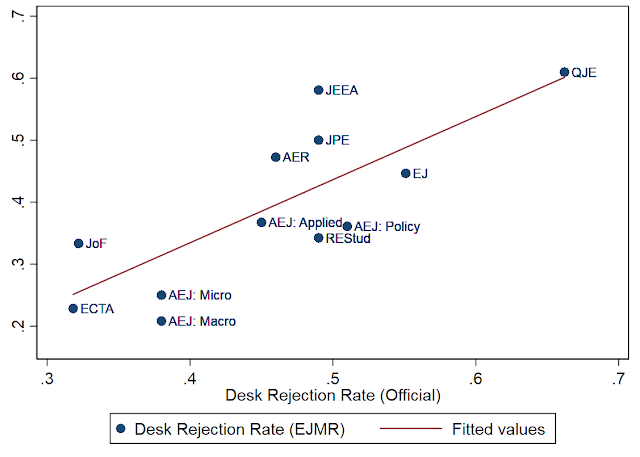
Here's the Data:
Overall, the data line up fairly well.
Here is the correlation in journal first-response times, conditional on being sent out for review. The R-squared is a respectable .52, although AEJ: Micro is an outlier on EJMR, where it actually does better than what the official statistics suggest (with N=16 though...). Author-reported weight times are about two weeks longer on average, but on ejmr, you round to the nearest month vs. day, so some difference isn't surprising.

Here is the correlation between desk rejections, author vs. journal reported. The regression coefficient is close to 1, and the R-squared is .63. The intercept is -.072, as average reported desk-rejections are lower on ejmr.

Here's the Data:
| Journal | Desk Reject Rate (EJMR) | Desk Reject (Official) | First Response Time, Conditional on Being Sent Out to Referees (EJMR) | First Response Time, Conditional on Being Sent Out to Referees (Official) |
| QJE | 61% | 66% | 1.5 | 1.5 |
| JPE | 50% | 49% | 8.0 | 4.0 |
| REStud | 34% | 49% | 4.5 | 3.4 |
| ECTA | 23% | 32% | 3.6 | 3.4 |
| AEJ: Macro | 21% | 38% | 2.9 | 3.4 |
| AEJ: Applied | 37% | 45% | 2.5 | 2.7 |
| Journal of Finance | 33% | 32% | 3.0 | 2.2 |
| AER | 47% | 46% | 3.7 | 3.1 |
| JEEA | 58% | 49% | 2.5 | 3.2 |
| AEJ: Policy | 36% | 51% | 2.8 | 3.1 |
| EJ | 45% | 55% | 3.7 | 3.6 |
| AEJ: Micro | 25% | 38% | 3.4 | 4.5 |
Monday, February 18, 2019
Ranking Economic Journals by Speed, Updated
I decided to update my previous ranking on economics journals ranked by speed.
In the table below, # is the journal's rank by citations (may be 2 years old, I didn't update this), and then there is data on the acceptance rate, desk rejection rate, average time to acceptance, median time to acceptance, and the 25th and 75th percentiles (all in terms of months). Only journals with at least 5 observations were included. Data come from here.
There are some similarities with the previous ranking by speed. The QJE is still the fastest, and the JME still brings up the rear -- despite the fact I've doubled the sample size.
One note is that I just copy-pasted and ran my previous code, so if you notice any errors below, please let me know.
My big hesitation with doing this is that I think it may not purely be a good thing to incentive journals to respond quickly. They tend to do this by desk-rejecting more papers, and I worry that desk-rejections are often done on the basis of institutional affiliation, or perhaps after a less-than-fully-thorough examination of the paper. I may do an updated version which conditions on the paper going out to journals. Nevertheless, if you are contemplating which journal to submit a paper to, this may be helpful.
In the table below, # is the journal's rank by citations (may be 2 years old, I didn't update this), and then there is data on the acceptance rate, desk rejection rate, average time to acceptance, median time to acceptance, and the 25th and 75th percentiles (all in terms of months). Only journals with at least 5 observations were included. Data come from here.
There are some similarities with the previous ranking by speed. The QJE is still the fastest, and the JME still brings up the rear -- despite the fact I've doubled the sample size.
One note is that I just copy-pasted and ran my previous code, so if you notice any errors below, please let me know.
My big hesitation with doing this is that I think it may not purely be a good thing to incentive journals to respond quickly. They tend to do this by desk-rejecting more papers, and I worry that desk-rejections are often done on the basis of institutional affiliation, or perhaps after a less-than-fully-thorough examination of the paper. I may do an updated version which conditions on the paper going out to journals. Nevertheless, if you are contemplating which journal to submit a paper to, this may be helpful.
| # | Journal Name | Accept % | Desk Reject % | Avg. Time | Median Time | 25th Percent. (Months) | 75th Percent. (Months) | N = |
| 1 | Quarterly Journal of Economics | 1% | 61% | 0.59 | 0 | 0 | 1 | 82 |
| 80 | Journal of Economic Geography | 0% | 80% | 0.67 | 0 | 0 | 1 | 5 |
| 12 | Journal of the European Economic Association | 3% | 58% | 1.16 | 0 | 0 | 2 | 31 |
| 81 | Kyklos | 8% | 33% | 1.33 | 1 | 0.5 | 2 | 12 |
| 94 | Economics and Human Biology | 43% | 43% | 1.50 | 1 | 0 | 3 | 7 |
| 74 | Management Science | 18% | 45% | 1.55 | 2 | 0 | 2 | 22 |
| 15 | Review of Financial Studies | 11% | 37% | 1.59 | 2 | 0 | 2 | 27 |
| 78 | Demography | 0% | 80% | 1.60 | 1 | 0 | 2 | 5 |
| 14 | Journal of Human Resources | 15% | 54% | 1.60 | 1 | 0 | 3 | 46 |
| 31 | European Economic Review | 28% | 44% | 1.72 | 1 | 0 | 3 | 50 |
| 6 | American Economic Journal: Applied Economics | 8% | 37% | 1.76 | 2 | 0 | 3 | 49 |
| 13 | American Economic Journal: Economic Policy | 8% | 36% | 1.83 | 2 | 0 | 3 | 36 |
| 100 | China Economic Review | 67% | 33% | 1.83 | 2 | 0.5 | 2 | 9 |
| 7 | Journal of Finance | 0% | 33% | 2.05 | 2 | 0 | 3 | 21 |
| 19 | Journal of Financial Economics | 24% | 18% | 2.06 | 2 | 1 | 3 | 17 |
| 27 | Journal of Financial Intermediation | 14% | 29% | 2.14 | 3 | 1 | 3 | 7 |
| 9 | American Economic Review | 7% | 47% | 2.16 | 1 | 0 | 4 | 91 |
| 46 | Econometrics Journal | 0% | 50% | 2.17 | 0.5 | 0 | 5 | 6 |
| 55 | Review of Income and Wealth | 17% | 67% | 2.17 | 0.5 | 0 | 4 | 6 |
| 38 | Journal of Financial and Quantitative Analysis | 29% | 6% | 2.18 | 2 | 1 | 3 | 17 |
| 37 | Journal of Population Economics | 22% | 44% | 2.22 | 3 | 0 | 4 | 9 |
| 76 | Explorations in Economic History | 56% | 11% | 2.22 | 2 | 2 | 3 | 9 |
| 32 | Theoretical Economics | 8% | 0% | 2.23 | 2 | 2 | 2 | 13 |
| 90 | Economics Letters | 45% | 25% | 2.24 | 2 | 1 | 2 | 114 |
| 42 | Review of Finance | 0% | 8% | 2.25 | 2.5 | 1.5 | 3 | 12 |
| 16 | Economic Journal | 16% | 45% | 2.26 | 2 | 0 | 4 | 56 |
| 34 | Journal of Health Economics | 13% | 55% | 2.32 | 2 | 1 | 4 | 31 |
| 5 | American Economic Journal: Macroeconomics | 13% | 21% | 2.33 | 2 | 1.5 | 3 | 24 |
| 62 | Regional Science and Urban Economics | 52% | 14% | 2.35 | 2 | 2 | 3 | 21 |
| 65 | International Journal of Industrial Organization | 7% | 20% | 2.47 | 2 | 1 | 4 | 15 |
| 91 | Public Choice | 14% | 48% | 2.48 | 1 | 0 | 3 | 29 |
| 35 | Labour Economics | 9% | 27% | 2.55 | 2.5 | 2 | 3 | 22 |
| 41 | Journal of Law and Economics | 0% | 43% | 2.57 | 3 | 1 | 4 | 14 |
| 61 | Journal of Comparative Economics | 27% | 33% | 2.63 | 2 | 0.5 | 4.5 | 15 |
| 71 | European Journal of Political Economy | 38% | 23% | 2.69 | 2 | 2 | 3 | 13 |
| 58 | B.E. Journals in Economic Analysis & Policy | 33% | 7% | 2.71 | 3 | 1 | 4 | 15 |
| 26 | Journal of Urban Economics | 22% | 17% | 2.72 | 3 | 1 | 4 | 18 |
| 30 | American Economic Journal: Microeconomics | 19% | 25% | 2.74 | 3 | 1 | 4 | 16 |
| 4 | Econometrica | 6% | 23% | 2.77 | 3 | 1 | 4 | 35 |
| 24 | Journal of Applied Econometrics | 9% | 35% | 2.78 | 2 | 0 | 5 | 23 |
| 57 | Industrial and Labor Relations Review | 27% | 36% | 2.82 | 2 | 1 | 5 | 11 |
| 64 | The Journal of Law, Economics, and Organization | 18% | 27% | 2.82 | 3 | 2 | 4 | 11 |
| 85 | Energy Journal | 38% | 0% | 2.88 | 3 | 2 | 3.5 | 8 |
| 36 | World Bank Economic Review | 8% | 31% | 2.92 | 2 | 2 | 4 | 13 |
| 11 | Journal of Labor Economics | 0% | 32% | 3.00 | 3 | 0 | 6 | 19 |
| 21 | Journal of Public Economics | 12% | 27% | 3.10 | 3 | 1 | 4 | 60 |
| 83 | American Journal of Health Economics | 43% | 0% | 3.14 | 3 | 2 | 4 | 7 |
| 3 | Review of Economic Studies | 4% | 34% | 3.16 | 3 | 0 | 5 | 73 |
| 23 | Journal of Development Economics | 17% | 41% | 3.16 | 3 | 1 | 4 | 54 |
| 63 | Oxford Economic Papers | 17% | 42% | 3.23 | 3 | 1 | 5 | 12 |
| 67 | Journal of Banking and Finance | 18% | 18% | 3.25 | 3 | 2 | 4 | 28 |
| 87 | Southern Economic Journal | 14% | 14% | 3.29 | 4 | 2 | 4 | 7 |
| 99 | American Journal of Agricultural Economics | 23% | 0% | 3.31 | 3 | 3 | 4 | 13 |
| 82 | Journal of Macroeconomics | 31% | 25% | 3.31 | 3 | 0.5 | 5.5 | 16 |
| 69 | Economics and Politics | 40% | 0% | 3.33 | 3 | 1 | 6 | 5 |
| 89 | Journal of Economic History | 17% | 0% | 3.33 | 3 | 2 | 4 | 6 |
| 93 | Review of Economics of the Household | 20% | 10% | 3.46 | 3 | 1 | 3 | 10 |
| 17 | Journal of Economic Growth | 0% | 0% | 3.50 | 2.5 | 2 | 3 | 10 |
| 92 | Small Business Economics | 25% | 25% | 3.50 | 3 | 1.5 | 5 | 8 |
| 10 | Review of Economics and Statistics | 2% | 48% | 3.51 | 2 | 0 | 5 | 65 |
| 56 | Journal of Economic Behavior and Organization | 30% | 27% | 3.67 | 4 | 0 | 6 | 33 |
| 25 | Journal of Business and Economic Statistics | 20% | 10% | 3.70 | 2.5 | 2 | 5 | 10 |
| 49 | Canadian Journal of Economics | 28% | 6% | 3.72 | 4 | 3 | 5 | 18 |
| 53 | Economics of Education Review | 50% | 7% | 3.79 | 4 | 2 | 5 | 14 |
| 51 | Journal of Industrial Economics | 13% | 33% | 3.81 | 4 | 1.5 | 5.5 | 15 |
| 88 | World Development | 39% | 37% | 3.92 | 3 | 1 | 6 | 49 |
| 33 | Journal of Economic Theory (Elsevier) | 21% | 18% | 3.94 | 4 | 3 | 5 | 33 |
| 22 | RAND Journal of Economics | 6% | 21% | 3.97 | 4 | 3 | 5 | 34 |
| 68 | Macroeconomics Dynamics (Cambridge) | 57% | 21% | 4.07 | 4 | 1 | 6 | 14 |
| 28 | Experimental Economics | 38% | 8% | 4.08 | 3 | 2 | 6 | 13 |
| 40 | Journal of Environmental Economics and Management | 24% | 8% | 4.15 | 3.5 | 2 | 5 | 25 |
| 45 | Econometric Theory | 0% | 40% | 4.20 | 4 | 0 | 5 | 5 |
| 84 | Health Economics | 8% | 50% | 4.21 | 3 | 3 | 6 | 12 |
| 44 | Journal of Economic Dynamics and Control | 50% | 14% | 4.22 | 3 | 1 | 4 | 22 |
| 54 | Journal of Economics and Management Strategy | 54% | 8% | 4.23 | 3 | 3 | 6 | 13 |
| 66 | International Tax and Public Finance | 14% | 14% | 4.29 | 3 | 2 | 7 | 7 |
| 60 | B.E. Journal of Macroeconomics | 63% | 0% | 4.33 | 4 | 2 | 6 | 8 |
| 75 | Economic Theory | 23% | 27% | 4.35 | 4 | 1 | 6 | 22 |
| 95 | Energy Economics | 55% | 0% | 4.42 | 4 | 3.5 | 6 | 11 |
| 98 | Economics of Transition | 71% | 14% | 4.50 | 4.5 | 2.5 | 6 | 7 |
| 47 | Oxford Bulletin of Economics and Statistics | 29% | 36% | 4.64 | 4 | 2 | 6 | 14 |
| 72 | Environmental and Resource Economics | 27% | 47% | 4.69 | 4 | 2.5 | 6.5 | 15 |
| 18 | Journal of International Economics | 18% | 6% | 4.71 | 3 | 3 | 6 | 17 |
| 43 | Journal of International Money and Finance | 40% | 5% | 4.75 | 3 | 2 | 7 | 20 |
| 97 | Journal of Corporate Finance | 14% | 14% | 4.75 | 3.5 | 3 | 6.5 | 7 |
| 73 | Review of International Economics | 30% | 10% | 4.91 | 3 | 3 | 6 | 10 |
| 52 | Games and Economic Behavior | 18% | 18% | 4.94 | 4 | 3 | 6 | 50 |
| 59 | Economic Development and Cultural Change | 27% | 20% | 5.00 | 4.5 | 3 | 6.5 | 15 |
| 48 | Economic Inquiry | 25% | 25% | 5.18 | 3 | 2 | 7 | 36 |
| 39 | Journal of Economic Surveys | 0% | 40% | 5.20 | 5 | 0 | 7 | 5 |
| 2 | Journal of Political Economy | 0% | 50% | 5.34 | 3 | 2 | 8 | 32 |
| 96 | Empirical Economics | 44% | 13% | 5.56 | 5.5 | 3.5 | 6 | 16 |
| 50 | Economica | 11% | 53% | 5.57 | 3 | 1 | 6 | 19 |
| 20 | Journal of Money, Credit, and Banking | 13% | 13% | 5.72 | 4.5 | 2.5 | 9 | 30 |
| 77 | Journal of Public Economic Theory | 27% | 18% | 5.86 | 6 | 3 | 9 | 11 |
| 79 | The World Economy | 40% | 0% | 6.25 | 5 | 3.5 | 8.5 | 5 |
| 70 | Econometric Reviews | 33% | 0% | 6.86 | 7 | 4 | 10 | 6 |
| 29 | Journal of Econometrics | 10% | 10% | 6.90 | 6.5 | 5 | 10 | 10 |
| 86 | Journal of Empirical Finance | 38% | 0% | 8.22 | 7 | 6 | 13 | 8 |
| 8 | Journal of Monetary Economics | 21% | 11% | 9.12 | 6 | 4 | 11 | 19 |
Tuesday, February 6, 2018
On the Uses (and Abuses) of Economath: The Malthusian Models
Many American undergraduates in Economics interested in doing a Ph.D. are surprised to learn that the first year of an Econ Ph.D. feels much more like entering a Ph.D. in solving mathematical models by hand than it does with learning economics. Typically, there is very little reading or writing involved, but loads and loads of fast algebra is required. Why is it like this?

The first reason is that mathematical models are useful! Take the Malthusian Model. All you need is four simple assumptions: (1) that the birth rate is increasing in income, (2) that the death rate is decreasing in income, (3) that income per person is negatively related to population, and (4) the rate of technological growth is slow relative to population growth, and you can explain a lot of world history, and it leads you to the surprising conclusion that income in a Malthusian economy is determined solely by birth and death rate schedules, and is uncorrelated with technology. Using this model, you can explain, for example, why incomes before 1800 were roughly stagnant for centuries despite improving technology (technological advance just resulted in more people; see the graph of income proxied by skeletal heights below). It also predicts why the Neo-Europes -- the US/Australasia/Southern Cone countries are rich -- they were depopulated by disease, and then Europeans moved in with lots of land per person. It is a very simple, and yet powerful, model. And it makes (correct) predictions that many historians (e.g., Kenneth Pomeranz), scientists (e.g., Jared Diamond), and John Bates Clark-caliber economists (see below) get wrong.

A second beneficial reason is signalling. This reason is not to be discounted given the paramount importance of signalling in all walks of life (still not sufficiently appreciated by all labor economists). Smart people do math. Even smarter people do even more complicated-looking math. I gratuitously put a version of the Melitz model in my job market paper, and when I interviewed, someone remarked that I was "really teched up!" Simple models are not something that serious grown-ups partake in. Other social science disciplines have their own versions of peacock feathers. In philosophy, people write in increasingly obtuse terms, using obscure language and jargon, going through enormous effort to use words requiring as many people as possible to consult dictionaries. Unfortunately, the Malthusian model above, while effective in terms of predictive power, is far too simple to play a beneficial signalling role, and as a result would likely have trouble getting published if introduced today.
A third reason to use math is that it is easy to use math to trick people. Often, if you make your assumptions in plain English, they will sound ridiculous. But if you couch them in terms of equations, integrals, and matrices, they will appear more sophisticated, and the unrealism of the assumptions may not be obvious, even to people with Ph.D.'s from places like Harvard and Stanford, or to editors at top theory journals such as Econometrica. A particularly informative example is the Malthusian model proposed by Acemoglu, Johnson, and Robinson in the 2001 version of their "Reversal of Fortune" paper (model starts on the bottom of page 9). Note that Daron Acemoglu is widely regarded as one of the most brilliant economic theorists of his generation, is a tenured professor of Economics at MIT, was recently the editor of Econometrica (the top theory journal in all of economics), and was also awarded a John Bates Clark medal (the 2nd most prestigious medal in the profession) in large part for his work on this paper (and a closely related paper). Also keep in mind this paper was eventually published in the QJE, the top journal in the field. Very few living economists have a better CV than Daron Acemoglu. Thus, if we want to learn about how economath is used, we'll do best to start by learning from the master himself.
What's interesting about the Acemoglu et al. Malthusian model is that they take the same basic assumptions, assign a particular functional form to how population growth is influenced by income, and arrive at the conclusion that population density (which is proportional to technology) will be proportional to income! They use the model:
p(t+1) = rho*p(t) + lambda*(y-ybar) + epsilon(t),
where p(t+1) is population density at time t+1, p(t) is population at time t, rho is a parameter (perhaps just less than 1), lambda is a parameter, y is income, ybar is the level of Malthusian subsistence income, and epsilon is an error term. If you impose a steady state (p* and y*) and solve for p*, you get:
p* = 1/(1-rho)*lambda(y*-ybar)
I.e., you get that population density is increasing in income, and thus that income per person should have been increasing throughout history. Thus, these guys from MIT were able to use mathematics and overturn one of the central predictions of the Malthusian model. It is no wonder, then, that Acemoglu was then awarded a Clark medal for this work.
Except. This version doesn't necessarily fit the skeletal evidence above, although that evidence may be incomplete and imperfect (selection issues?). What exactly was the source of the difference in the classical Malthusian model and the "MIT" malthusian model? The crucial assumption, unstated in words but there in greek letters for anyone to see, was that income affects the level of population, but not the growth rate in population. Stated differently, this assumption means that a handful of individuals could and would out-reproduce the whole of China and India combined if they had the same level of income. (With rho less than one, say, .98, the first term will imply a contraction of millions of people in China/India. With income over subsistence, we then need to parameterize lambda to be large enough so that overall population can grow in China. But once we do this, we'll have the implication that even a very small population would have much larger absolute growth than China given the same income.) Obviously, this is quite a ridiculous assumption when stated in plain language. A population can grow by, at most, a few percent per year. 100 people can't have 3 million offspring. What this model does successfully is reveal how cloaking an unrealistic assumption in terms of mathematics can make said assumption very hard to detect, even by tenured economics professors at places like MIT. Math in this case is used as little more than a literary device designed to fool the feebleminded. Fortunately, someone caught the flaw, and this model didn't make the published version in the QJE. Unfortunately, the published version still included the view that population density is a reasonable proxy for income in a Malthusian economy, which of course it is not. And the insight that Malthusian forces led to high incomes in the Neo-Europes was also lost.
Given that this paper then formed part of the basis of Acemoglu's Clark medal, I think we can safely conclude that people are very susceptible to bullshit when written in equations. More evidence will come later in the comments section, as, conditioned on getting hits, I suspect several people will be taken in by the AJR model, and will defend it vigorously.
This episodes shows some truth to Bryan Caplan's view that "The main intellectual benefit of studying economath ... is that it allows you to detect the abuse of economath."
Given the importance of signaling in all walks of life, and given the power of math, not just to illuminate and to signal, but also to trick, confuse, and bewilder, it thus makes perfect sense that roughly 99% of the core training in an economics Ph.D. is in fact in math rather than economics.
Update: Sure enough, as I predicted above, we have a defender of the AJR model in the comments. He argues the AJR model shows why math clarifies, even while his posts unwittingly convey the opposite.
Above, I took issue with the steady state relationship in the model and the fallacious assumption which yields it. The commenter points out correctly, that, outside of the steady state, the AJR model actually implies that there are two conflicting forces. But, so what? My argument was about the steady state. If one fixes the wrong assumption, steady-state income in the Malthusian model will be equal to subsistence income, and thus the main argument for correlation between population density and income outside of the steady state will also be shut down.
Second the commenter unfairly smears Acemoglu & Co., writing that the real problem is not with their model, but that they didn't interpret their model correctly: "goes ahead in the empirical work to largely, in contrast to what their model says, take population density as a proxy for income!".
Thus I'd like to defend Acemoglu against this unfair smear. In preindustrial societies, there were vast differences in population densities between hunter-gatherer groups, and agricultural societies, even though there were not vast income differences between the two. In fact, quite surprisingly, hunter-gatherer societies often look to have been richer despite working less (read Greg Clark), and despite far more primitive technology. Thus it is quite reasonable to assume, as AJR did, that it is likely that differences in technology would swamp the differences in other population shocks (A more important than epsilon). The Black Death might have doubled or tripled incomes, but settled agrarian societies might have population densities 1000 times as large as primitive hunter-gatherer tribes. This isn't an airtight argument, but, given their model, I believe AJR's empirical extension is reasonable, particularly given that they provide a caveat. The problem is that their model is not reasonable.
The commenter goes on to argue that I've gotten AJR's conclusion backward: "You claim that the point they are making is "population density will be a decent proxy for income in a Malthusian model." The point they are making is explicitly the exact opposite: that "caution is required in interpreting population density as a proxy for income per capita."
Huh? The first two lines of the abstract of the AJR paper read: "Among countries colonized by European powers during the past 500 years, those that were relatively rich in 1500 are now relatively poor. We document this reversal using data on urbanization patterns and population density, which, we argue, proxy for economic prosperity."
Seems clear here they are arguing for using it as a proxy.
Update: Sure enough, as I predicted above, we have a defender of the AJR model in the comments. He argues the AJR model shows why math clarifies, even while his posts unwittingly convey the opposite.
Above, I took issue with the steady state relationship in the model and the fallacious assumption which yields it. The commenter points out correctly, that, outside of the steady state, the AJR model actually implies that there are two conflicting forces. But, so what? My argument was about the steady state. If one fixes the wrong assumption, steady-state income in the Malthusian model will be equal to subsistence income, and thus the main argument for correlation between population density and income outside of the steady state will also be shut down.
Second the commenter unfairly smears Acemoglu & Co., writing that the real problem is not with their model, but that they didn't interpret their model correctly: "goes ahead in the empirical work to largely, in contrast to what their model says, take population density as a proxy for income!".
Thus I'd like to defend Acemoglu against this unfair smear. In preindustrial societies, there were vast differences in population densities between hunter-gatherer groups, and agricultural societies, even though there were not vast income differences between the two. In fact, quite surprisingly, hunter-gatherer societies often look to have been richer despite working less (read Greg Clark), and despite far more primitive technology. Thus it is quite reasonable to assume, as AJR did, that it is likely that differences in technology would swamp the differences in other population shocks (A more important than epsilon). The Black Death might have doubled or tripled incomes, but settled agrarian societies might have population densities 1000 times as large as primitive hunter-gatherer tribes. This isn't an airtight argument, but, given their model, I believe AJR's empirical extension is reasonable, particularly given that they provide a caveat. The problem is that their model is not reasonable.
The commenter goes on to argue that I've gotten AJR's conclusion backward: "You claim that the point they are making is "population density will be a decent proxy for income in a Malthusian model." The point they are making is explicitly the exact opposite: that "caution is required in interpreting population density as a proxy for income per capita."
Huh? The first two lines of the abstract of the AJR paper read: "Among countries colonized by European powers during the past 500 years, those that were relatively rich in 1500 are now relatively poor. We document this reversal using data on urbanization patterns and population density, which, we argue, proxy for economic prosperity."
Seems clear here they are arguing for using it as a proxy.
Wednesday, January 24, 2018
Reminder: Most Published Research is Probably Wrong!
At least in some way. Don't get me wrong, there is a lot of great research out there. However, it has occured to me that many people are much too trusting of published research, particularly when written by people from fancy universities with fancy letters behind their names and when published in prestigious journals. I saw this recently during a very lively session on the Decline in US Manufacturing Growth and Productivity at the AEA meetings in Philadelphia several weeks ago. Several people asked David Autor why his results on the impact of China on US innovation was different from what other prominent researchers had found. (One of the answers, of course, is that there is little reason to believe the competing research, but I digress...) Similarly, one of my complaints of the otherwise excellent Trade Talks podcast with Chad Bown is that published results, particularly by prominent researchers, are generally taken at face value, with not enough discussion, in my view, about potential caveats and shortcomings of the methodologies employed.
The reality is that science is difficult, and that Cowen's First Law (there is something wrong with everything!) applies to economic research.
Here's a moving video from Neil Degrasse Tyson which I mostly love. My only issue was his description of science:
One of the great things about science, is that it's an entire exercise in finding what is true.This is a description of everything I wish science was! Perhaps it is an accurate description of hard sciences (I'm skeptical), but this is not how the social sciences operate. In practice, when a top researcher has a major finding, other top researchers, with rare exceptions, do not check it. Occasionally, grad students or less prominent researchers will overturn the result, but they will find that journals simply aren't the least bit interested in publishing papers which reverse seminal papers. Thinking like an economist, this creates some rather perverse incentives. If you are a well-connected researcher in a prominent department, you are well-incentivized to publish as much as possible. This means creating research which appears sophisticated, and it also means not pissing off the people who will judge your research. On the contrary, implies that there are benefits from having a lot of close friends (what deGrasse calls your "rivals") in the profession. You don't accomplish this by pointing out that another researcher's results disappear when you control for latitude. As a result, many top researchers are in fact incentivized to crank out many low-quality papers but with seemingly blockbuster results.
You have a hypothesis, you test it. I get a result. A rival of mine double checks it, because they think I might be wrong. They perform an even better experiment than I did, and they find out, “Hey, this experiment matches! Oh my gosh. We’re on to something here!” And out of this rises a new, emergent truth.
Part of the way this system survives is because there is a culture frowning on writing "comment papers", and the other reason is that there is, fortunate for the existence of this system, a willing population of "sheep", the "true believers", available to consume and believe this research.
In any case, on my ride back to Moscow from Philadelphia, I fired up Stata, and took a second look at some of the research which found that the China shock led to a huge increase in productivity and patenting in Europe, published in a leading journal. The thesis sounded quite dubious to me from the beginning. It turned out that including sectoral fixed effects -- a very basic control -- killed the results. If I were to write this up, the journal that published it would never, in a million years, accept it. Secondly, although the original authors seem to me like fine people, traditionally, economists behave in a way which is mafia-level shady (see the comments) when their research comes under attack. Partly, they have to do this, since the masses believe that most top research is correct, it is seen as a huge black mark on someone's reputation to have a paper overturned. If there was widespread knowledge that science is difficult and most papers have flaws, this might not be so necessary. Then, perhaps, we could get a bit closer to Neil Degrasse Tyson's idealized view of science.
Monday, December 11, 2017
Janet Yellen's Tenure, in Retrospect (Has the Economy Really Recovered?)
On Twitter, Paul Romer lauds the job that Janet Yellen has done, writing that "In an extraordinarily difficult political context, J. Yellen did an extraordinarily important public policy job extraordinarily well."
However, I've long been a skeptic of the job that both Ben Bernanke and Janet Yellen have done. (Seems I'm the only one who remembers that 2010 discount rate hike, with GDP 20% below trend, she voted for, which helped spawn the Tea Party...) The economy never had a full recovery, as growth is still slow and inflation is still below target. I once explained this to a colleague, and she told me that "Sorry, but I don't think you are smarter than Ben Bernanke. He knows more about monetary policy than you." When I was at the CEA, virtually everyone else there thought I was the stupid one, and that Ben-"When Growth is Not Enough"-Bernanke's policy was roughly optimal.
Of course, this is long before Ben Bernanke himself amended his views, to say that central banks should do price-level targeting when exiting a liquidity trap. I.e., Ben Bernanke (2017) thinks the Fed should have aimed for higher inflation in the 2009 to 2014 period, whereas Ben Bernanke (2009-2014) seemed to be content with below-target inflation, much less inflation over and above the inflation target. That Bernanke (and Yellen) also believed that when growth and inflation were below forecast, a central bank should not provide more stimulus, but instead lower the forecasts.
However, Bernanke's reappraisal isn't just a repudiation of the views of the 2009 to 2014 Ben Bernanke, but also a repudiation of the views of Janet Yellen over this period. Of course, Janet has only been the Chair since 2014. Since that time, she has seen fit to end QE and raise interest rates repeatedly. So, let's do some Monday-morning quarterbacking on how well this has gone.

In terms of the Core PCE deflator, inflation has been below the Fed's own target under Yellen's entire term, and is currently nowhere near the target. In addition, there's a good case to be made that the Fed's inflation target is, itself, too low. And then there is Bernanke's argument, that, coming out of a liquidity trap period, central banks should aim for temporarily high inflation. Yellen's record here is not good.
How about with GDP growth and employment? If all is well there, slightly lower inflation would not be a real problem. However, here is Real GDP relative to the long-run trend.

Note that the US is well below it's long-run growth trend, and getting further away from it. The near-consensus among economists, interestingly enough, is that most everything that can be invented has already been invented, and there just isn't that much "stuff" left. Yes, really. I think that is nonsense (the iphone was invented in 2007!). In fact the cause is the China (+RER) shock, and then poor regulation during the housing bubble, and poor monetary policy managing the liquidity trap. This is all fairly obvious by now. Strange it isn't already the consensus. But slow inflation along with slow growth suggests that the problem isn't some structural supply problem, but due to a shortfall of demand.
However, to be fair to Paul Romer, unemployment is way down. This is a good sign, and an indicator that the labor market has improved.

However, it is not the only labor market indicator, and thus, by itself, does not provide a full picture of the economy. The employment rate for prime-aged workers is another legitimate measure to look at, as the unemployment rate might look good if many people have simply left the labor force. And, the prime-age employment rate below shows that, while the US has made steady progress, it is not quite back to the level it was at in 2007. In addition, the 2007 peak, which came after 7 years of relatively slow GDP growth despite a housing bubble, and was also the decade of the collapse in manufacturing employment, was significantly lower than the 2000 peak. (The overall employment-to-population ratio still looks terrible.)

However, even this measure is flawed in several respects. One problem is that, given heavy baby boomer retirement, more jobs have opened up for younger workers than would otherwise be the case. While I don't think an adjustment for this would change the picture that much, we might actually deduct a quarter to a half of a percent for this.
A second factor is that the several decades since the 1970s had saw increasing numbers of women enter the labor force. Optimists may say that this trend was simply complete by 2000. But, even since then, we have seen female employment continue to increase on a relative basis. Thus, I would say that our baseline shouldn't be the 2000 peak, but that we should have expected emp-to-pop to have increased more than this. How much more? Perhaps another .25 or .5%. A good paper could probably tease this out. Again, I don't think this necessitates a large adjustment. But, these are starting to add up, and means we might still be 3.5-4% below where we should be.
The graph of the female prime-aged employment rate shows that female employment has essentially recovered back to its level in 2007. This means that it is still gaining ground relative to male employment, even since 2000. And, it is still about 7% lower than the overall employment rate.

A third factor is that just because people are working, it doesn't mean they are doing work they are happy with, or have seen the wage growth they would like. Here is the part-time employment rate, which is still elevated, and presents a rather pessimistic figure. But, if more people are working part-time, this is an indication that other people who are working full-time are not employed in their ideal jobs, but would rather have better jobs with higher salaries. And, of course, given the slower GDP growth, incomes have not grown as fast as they used to.

Obviously, incomes are also not increasing as fast as they used to.

Sure, inflation is also low, but GDP growth is slow. That both are slow is an indication that the economy is demand constrained. Why is it demand constrained? Well, the end of QE and four rate hikes are certainly part of the story. Those rate hikes caused the dollar to appreciate, inflation to subside, and more manufacturing jobs to be lost. And this is Janet Yellen's doing. This wasn't a one-time mistake either. She repeatedly failed to hit her inflation target, with slow GDP, and never re-thought the course the Fed was on.
The defence of Yellen (and also of Bernanke) is that she might have liked to have been more accommodative over much of this period, but also had to deal with more conservative elements on the Board (see here).
To get a sense of how competent the people around Yellen at the Fed have been, read this stream of jaw-dropping quotes, stolen from a commenter here on Scott Sumner's excellent blog:
The 2008 “Dream Team”
SEPTEMBER 16, 2008 FOMC TRANSCRIPT
SELECTED QUOTES EXCERPTED FROM ROUNDTABLE DISCUSSION
MR DUDLEY
Either the financial system is going to implode in a major way, which will lead to a significant further easing, or it is not.
MR LOCKHART
But I should follow the philosophy of Charlie Brown, who I think said, “Never do today what you can put off until tomorrow.” [Laughter]
MR ROSENGREN
Deleveraging is likely to occur with a vengeance as firms seek to survive this period of significant upheaval… I support alternative A to reduce the fed funds rate 25 basis points. Thank you.
Mr HOENIG.
I also encourage us to look beyond the immediate crisis, which I recognize is serious. But as pointed out here, we also have an inflation issue. Our core inflation is still above where it should be.
MS YELLEN. I agree with the Greenbook’s assessment that the strength we saw in the upwardly revised real GDP growth in the second quarter will not hold up. Despite the tax rebates, real personal consumption expenditures declined in both June
and July, and retail sales were down in August. My contacts report that cutbacks in spending are widespread, especially for discretionary items. For example, East Bay plastic surgeons and dentists note that patients are deferring elective procedures. [Laughter]
MR BULLARD
Meanwhile, an inflation problem is brewing. The headline CPI inflation rate, the one consumers actually face, is about 6¼ percent year-to-date…My policy preference is to maintain the federal funds rate target at the current level and to wait for some time to assess the impact of the Lehman bankruptcy filing, if any, on the national economy.
MR PLOSSER
As I said, it is my view that the current stance of policy is inconsistent with price stability in the intermediate term and so rates ultimately will have to rise.
MR STERN
Given the lags in policy, it doesn’t seem that there is a heck of a lot we can do about current circumstances, and we have already tried to address the financial turmoil. So I would favor alternative B as a policy matter. As far as language is concerned with regard to B, I would be inclined to give more prominence to financial issues. I think you could do that maybe by reversing the first two sentences in paragraph 2. You would have to change the transitions, of
course.
MR. EVANS
But I think we should be seen as making well-calculated moves with the funds rate, and the current uncertainty is so large that I don’t feel as though we have enough information to make such calculations today.
MS PIANALTO
Given the events of the weekend, I still think it is appropriate for us to keep our policy rate unchanged. I would like more time to assess how the recent events are going to affect the real economy. I have a small preference for the assessment-of-risk language under alternative A.
MR LACKER
In fact, it’s heartening that compensation growth is coming in a little below expected in response to the energy price shock this year. This has allowed us to accomplish the inevitable decline in real wages without setting off an inflationary acceleration in wage rates.
MR. HOENIG
I think what we did with Lehman was the right thing because we did have a market beginning to play the Treasury and us, and that has some pretty negative consequences as well, which we are now coming to grips with.
MR. ROSENGREN
I think it’s too soon to know whether what we did with Lehman is right. Given that the Treasury didn’t want to put money in, what happened was that we had no choice…I hope we get through this week. But I think it’s far from clear, and we were taking a bet, and I hope in the future we don’t have to be in situations where we’re taking bets.
Mr. FISHER. All of that reminds me—forgive me for quoting Bob Dylan—but money doesn’t talk; it swears. When you swear, you get emotional. If you blaspheme, you lose control. I think the main thing we must do in this policy decision today is not to lose control, to show a steady hand. I would recommend, Mr. Chairman, that we embrace unanimously—and I think it’s important for us to be unanimous at this moment—alternative B
MR WARSH.
Those would be my suggestions to try to strike that balance—that we are keenly focused on what’s going on, but until we have a better view of its implications, we are not going to act.
The optimistic view of Yellen is that, while overall policy was quite inappropriately tight for essentially the entire period since 2008, Yellen may have been struggling all the time against these clowns in private, leading policy on a less-bad course. It seems this was partly true, but this case remains to be made, however, as I see no evidence that she wasn't in favor of the rate hikes as Fed Chair. She also could have talked Obama into making timely appointments in 2009 and 2010, to try to get policy back on track. Instead, she voted for a rate hike in 2010. I viewed this as unforgivable at the time, and it even looks worse in retrospect.
Of course, she also got unlucky. Had it not been for Comey, her mistakes as Fed Chair would likely not have led to Donald Trump.
Note: follow me on twitter @TradeandMoney
However, I've long been a skeptic of the job that both Ben Bernanke and Janet Yellen have done. (Seems I'm the only one who remembers that 2010 discount rate hike, with GDP 20% below trend, she voted for, which helped spawn the Tea Party...) The economy never had a full recovery, as growth is still slow and inflation is still below target. I once explained this to a colleague, and she told me that "Sorry, but I don't think you are smarter than Ben Bernanke. He knows more about monetary policy than you." When I was at the CEA, virtually everyone else there thought I was the stupid one, and that Ben-"When Growth is Not Enough"-Bernanke's policy was roughly optimal.
Of course, this is long before Ben Bernanke himself amended his views, to say that central banks should do price-level targeting when exiting a liquidity trap. I.e., Ben Bernanke (2017) thinks the Fed should have aimed for higher inflation in the 2009 to 2014 period, whereas Ben Bernanke (2009-2014) seemed to be content with below-target inflation, much less inflation over and above the inflation target. That Bernanke (and Yellen) also believed that when growth and inflation were below forecast, a central bank should not provide more stimulus, but instead lower the forecasts.
However, Bernanke's reappraisal isn't just a repudiation of the views of the 2009 to 2014 Ben Bernanke, but also a repudiation of the views of Janet Yellen over this period. Of course, Janet has only been the Chair since 2014. Since that time, she has seen fit to end QE and raise interest rates repeatedly. So, let's do some Monday-morning quarterbacking on how well this has gone.

In terms of the Core PCE deflator, inflation has been below the Fed's own target under Yellen's entire term, and is currently nowhere near the target. In addition, there's a good case to be made that the Fed's inflation target is, itself, too low. And then there is Bernanke's argument, that, coming out of a liquidity trap period, central banks should aim for temporarily high inflation. Yellen's record here is not good.
How about with GDP growth and employment? If all is well there, slightly lower inflation would not be a real problem. However, here is Real GDP relative to the long-run trend.

Note that the US is well below it's long-run growth trend, and getting further away from it. The near-consensus among economists, interestingly enough, is that most everything that can be invented has already been invented, and there just isn't that much "stuff" left. Yes, really. I think that is nonsense (the iphone was invented in 2007!). In fact the cause is the China (+RER) shock, and then poor regulation during the housing bubble, and poor monetary policy managing the liquidity trap. This is all fairly obvious by now. Strange it isn't already the consensus. But slow inflation along with slow growth suggests that the problem isn't some structural supply problem, but due to a shortfall of demand.
However, to be fair to Paul Romer, unemployment is way down. This is a good sign, and an indicator that the labor market has improved.

However, it is not the only labor market indicator, and thus, by itself, does not provide a full picture of the economy. The employment rate for prime-aged workers is another legitimate measure to look at, as the unemployment rate might look good if many people have simply left the labor force. And, the prime-age employment rate below shows that, while the US has made steady progress, it is not quite back to the level it was at in 2007. In addition, the 2007 peak, which came after 7 years of relatively slow GDP growth despite a housing bubble, and was also the decade of the collapse in manufacturing employment, was significantly lower than the 2000 peak. (The overall employment-to-population ratio still looks terrible.)

However, even this measure is flawed in several respects. One problem is that, given heavy baby boomer retirement, more jobs have opened up for younger workers than would otherwise be the case. While I don't think an adjustment for this would change the picture that much, we might actually deduct a quarter to a half of a percent for this.
A second factor is that the several decades since the 1970s had saw increasing numbers of women enter the labor force. Optimists may say that this trend was simply complete by 2000. But, even since then, we have seen female employment continue to increase on a relative basis. Thus, I would say that our baseline shouldn't be the 2000 peak, but that we should have expected emp-to-pop to have increased more than this. How much more? Perhaps another .25 or .5%. A good paper could probably tease this out. Again, I don't think this necessitates a large adjustment. But, these are starting to add up, and means we might still be 3.5-4% below where we should be.
The graph of the female prime-aged employment rate shows that female employment has essentially recovered back to its level in 2007. This means that it is still gaining ground relative to male employment, even since 2000. And, it is still about 7% lower than the overall employment rate.

A third factor is that just because people are working, it doesn't mean they are doing work they are happy with, or have seen the wage growth they would like. Here is the part-time employment rate, which is still elevated, and presents a rather pessimistic figure. But, if more people are working part-time, this is an indication that other people who are working full-time are not employed in their ideal jobs, but would rather have better jobs with higher salaries. And, of course, given the slower GDP growth, incomes have not grown as fast as they used to.

Obviously, incomes are also not increasing as fast as they used to.

Sure, inflation is also low, but GDP growth is slow. That both are slow is an indication that the economy is demand constrained. Why is it demand constrained? Well, the end of QE and four rate hikes are certainly part of the story. Those rate hikes caused the dollar to appreciate, inflation to subside, and more manufacturing jobs to be lost. And this is Janet Yellen's doing. This wasn't a one-time mistake either. She repeatedly failed to hit her inflation target, with slow GDP, and never re-thought the course the Fed was on.
The defence of Yellen (and also of Bernanke) is that she might have liked to have been more accommodative over much of this period, but also had to deal with more conservative elements on the Board (see here).
To get a sense of how competent the people around Yellen at the Fed have been, read this stream of jaw-dropping quotes, stolen from a commenter here on Scott Sumner's excellent blog:
The 2008 “Dream Team”
SEPTEMBER 16, 2008 FOMC TRANSCRIPT
SELECTED QUOTES EXCERPTED FROM ROUNDTABLE DISCUSSION
MR DUDLEY
Either the financial system is going to implode in a major way, which will lead to a significant further easing, or it is not.
MR LOCKHART
But I should follow the philosophy of Charlie Brown, who I think said, “Never do today what you can put off until tomorrow.” [Laughter]
MR ROSENGREN
Deleveraging is likely to occur with a vengeance as firms seek to survive this period of significant upheaval… I support alternative A to reduce the fed funds rate 25 basis points. Thank you.
Mr HOENIG.
I also encourage us to look beyond the immediate crisis, which I recognize is serious. But as pointed out here, we also have an inflation issue. Our core inflation is still above where it should be.
MS YELLEN. I agree with the Greenbook’s assessment that the strength we saw in the upwardly revised real GDP growth in the second quarter will not hold up. Despite the tax rebates, real personal consumption expenditures declined in both June
and July, and retail sales were down in August. My contacts report that cutbacks in spending are widespread, especially for discretionary items. For example, East Bay plastic surgeons and dentists note that patients are deferring elective procedures. [Laughter]
MR BULLARD
Meanwhile, an inflation problem is brewing. The headline CPI inflation rate, the one consumers actually face, is about 6¼ percent year-to-date…My policy preference is to maintain the federal funds rate target at the current level and to wait for some time to assess the impact of the Lehman bankruptcy filing, if any, on the national economy.
MR PLOSSER
As I said, it is my view that the current stance of policy is inconsistent with price stability in the intermediate term and so rates ultimately will have to rise.
MR STERN
Given the lags in policy, it doesn’t seem that there is a heck of a lot we can do about current circumstances, and we have already tried to address the financial turmoil. So I would favor alternative B as a policy matter. As far as language is concerned with regard to B, I would be inclined to give more prominence to financial issues. I think you could do that maybe by reversing the first two sentences in paragraph 2. You would have to change the transitions, of
course.
MR. EVANS
But I think we should be seen as making well-calculated moves with the funds rate, and the current uncertainty is so large that I don’t feel as though we have enough information to make such calculations today.
MS PIANALTO
Given the events of the weekend, I still think it is appropriate for us to keep our policy rate unchanged. I would like more time to assess how the recent events are going to affect the real economy. I have a small preference for the assessment-of-risk language under alternative A.
MR LACKER
In fact, it’s heartening that compensation growth is coming in a little below expected in response to the energy price shock this year. This has allowed us to accomplish the inevitable decline in real wages without setting off an inflationary acceleration in wage rates.
MR. HOENIG
I think what we did with Lehman was the right thing because we did have a market beginning to play the Treasury and us, and that has some pretty negative consequences as well, which we are now coming to grips with.
MR. ROSENGREN
I think it’s too soon to know whether what we did with Lehman is right. Given that the Treasury didn’t want to put money in, what happened was that we had no choice…I hope we get through this week. But I think it’s far from clear, and we were taking a bet, and I hope in the future we don’t have to be in situations where we’re taking bets.
Mr. FISHER. All of that reminds me—forgive me for quoting Bob Dylan—but money doesn’t talk; it swears. When you swear, you get emotional. If you blaspheme, you lose control. I think the main thing we must do in this policy decision today is not to lose control, to show a steady hand. I would recommend, Mr. Chairman, that we embrace unanimously—and I think it’s important for us to be unanimous at this moment—alternative B
MR WARSH.
Those would be my suggestions to try to strike that balance—that we are keenly focused on what’s going on, but until we have a better view of its implications, we are not going to act.
The optimistic view of Yellen is that, while overall policy was quite inappropriately tight for essentially the entire period since 2008, Yellen may have been struggling all the time against these clowns in private, leading policy on a less-bad course. It seems this was partly true, but this case remains to be made, however, as I see no evidence that she wasn't in favor of the rate hikes as Fed Chair. She also could have talked Obama into making timely appointments in 2009 and 2010, to try to get policy back on track. Instead, she voted for a rate hike in 2010. I viewed this as unforgivable at the time, and it even looks worse in retrospect.
Of course, she also got unlucky. Had it not been for Comey, her mistakes as Fed Chair would likely not have led to Donald Trump.
Note: follow me on twitter @TradeandMoney
Wednesday, November 29, 2017
An Economist's Take on Bitcoin and Cryptocurrencies: It's a Giant Scam and the Mother of All Bubbles
Bitcoin has climbed over $10,000 (when I first drafted this post last week, it was at just $8,200). The cryptocurrency market now appears like a full stock market of fake stocks, with a market cap of $245 billion (update a week later: $345 billion), more than 1% of the capitalization of the US stock market. My take on bitcoin is the standard boring economists' take: bitcoin and other cryptocurrencies are the mother of all irrational bubbles. The South Seas Bubble, Tulip Mania, the Nifty Fifty, and the dot.com bubble were all similar. And, if you'd listened to me (and us economists), you're continuing to live in relative poverty as your friends get rich, with money and wealth coming out of nowhere and millionaires minted overnight.
Theoretically, some other problems with bitcoin is that there is free entry. Anyone can create an infinite amount of cryptocurrency out of thin air. The marginal cost is zero. The saving grace is that there are network effects -- a currency becomes more valuable the more people that use it, and so it will be tough for other cryptocurrencies to displace bitcoin. However, that can't explain why there are thousands of cryptocurrencies with huge market caps. Only 1-2 of these will ultimately be the victor, and bitcoin is likely to be one of them.
Another issue with bitcoin/cryptocurrencies long-term is that if they ever did replace actual currencies in everyday transactions, governments could really lose out. The Federal Reserve would lose control over monetary policy, for example, and to the extent cryptocurrencies enable drug smugglers and hackers and others to evade the authorities and paying taxes, this should be something which governments will have a real interest in illegalizing. Thus, there is no endgame where bitcoin replaces the US dollar, the Chinese Yuan, or the Euro as the primary currency of a major economy. It is simply too volatile, and there will be nothing to stabilize its value.
The real economic argument for bitcoin is not that it actually provides cheap transaction fees, but rather that it is a really good scam/meme. It's techy, it's complicated, and few people understand it. Those who spent the time to learn how it really works then become part of the cult and evangelize over it. It could be compared to the spread of a religion: If many people very fervently buy into it, it could be a bubble that lasts a long time. This is the optimistic case for bitcoin. There are a group of Japanese in Brazil who went to their graves believing that Japan didn't lose WWII, and it was just US propaganda that suggested otherwise. The bitcoin true believers/dead-enders may hold bitcoin until the day they die, giving it a positive value for a long time to come.
Or, it could be more like the spread of a disease (I'm stealing this from Robert Shiller). To grow, the disease needs a lot of new people to infect. Once about 20-30% of the people are infected, it's growth will be at a maximum. But, over time, there are fewer and fewer new people to infect, as most people have had the disease, and the rate of new infections crashes. Bitcoin may not be so different -- the early adopters buy in, sending the price up. The higher price means more news, and is a positive feedback loop as the mainstreamers start to buy. Doubt creeps into the minds of naysayers, who might have believed it to be a scam initially, but now see the price soaring, against their predictions.
Usually the moment to sell is after almost everyone who is a quick adopter has already adopted, the median person has too, and the moment at which people who are typically late adopters start to invest. At that point, the economy will run out of suckers, and the price will start to stagnate and fall. Legend has it that Joe Kennedy sold his stocks in 1929 after a shoeshine boy started giving him stock tips. An older family member of mine was day-trading tech stocks in the 1990s, and then bought a condo in Florida in 2006. This person is my bellwether.
Given this may be a reason to buy in the near term, before the late adopters get wind (and, damnit!, why didn't I realize early on that this was a good scam!), be warned that just as the positive feedback loop works well on the way up, and it can work in reverse on the way down. A few bad days, and panic selling can ensue. Once it crashes, a generation of people could be so turned off by crypto they'll never touch it again.
What crypto does is settle the debate over whether fundamentals drive stock prices and exchange rates. I gave a talk at LSE a few weeks ago on my research on exchange rates and manufacturing, and someone stated their belief that exchange rates are driven by fundamentals (monetary policy) and so it was monetary policy which drove my results and not exchange rates, per se. However, as we see with bitcoin, which isn't driven by any kind of fundamental economic value, as it pays no dividends and has high transaction fees, bubbles can happen and markets aren't that efficient. (OK, even if you believe in bitcoin, how much do you believe in Sexcoin, Dogecoin, or "Byteball bites", the latter of which has a market cap of a cool $187 million...) There is never going to be a day when everyday people use "byteball bites" to buy groceries.
It also shows another reason why governments might want to tax windfall profits or large capital gains at a higher rate. Those profiting from cryptocurrency are incredibly lucky. Their "investments" don't leave any reason to deserve favorable income treatment relative to wage income. Stock market earnings are similar. Luck is involved just as much as skill.
Lastly, though, let me state my agreement with others that government-sponsored electronic currencies are probably a thing of the near future. If an electronic currency allows every transaction (or most transactions) to be traced by the government, it can cut down on illegal activity, narcotics, and tax evasion. A government could really very easily broaden the tax base, and raise more revenue while cutting taxes on law abiding citizens. This will probably help developing countries (like Russia) where tax evasion is rampant the most. I guess this will happen soon. Greece should do this and leave the Euro system (but not the EU!). Obviously, a digital currency also solves the problem of the zero lower bound on interest rates, reason enough to do it. Were I the Autocrat of All the Russians, I'd have implemented this already.
In any case, I don't want to give anyone investment advice. I have no clue what will happen to the price of bitcoin, although that should be a warning. I hope none of my friends miss out on the huge boom as bitcoin goes from $10,000 to $100,000 just because they read this. Just be for-warned that what goes up must come down. If you do ride the wave up, think about taking something off the table and try to remain diversified. (That goes for the US stock market too, which also now looks quite overvalued...) Once your parents start to buy bitcoin, that's probably a good time to cash out.
 |
| Pictured here with Nobel Prize Winner Robert Shiller, fortunate to experience a balmy -7 degrees in Moscow. He also believes that bitcoin is in a huge bubble. |
Despite my view that this is a standard bubble, I tried to buy bitcoin last summer (back at the bargain price of $4,000...), in part because I wanted to see how easy it was to use bitcoin to send money back to the US from Russia. After all, the logic behind bitcoin is that it is a super easy, cheap and fast way to send money. Exactly what I needed. The difficulty I went through in trying to purchase bitcoin only confirmed my worst fears of why I think it is a scam/ponzi scheme. Part of the problems I faced were no doubt specific to me, as a US national living in Russia. Many bitcoin exchanges are country specific, and didn't like my Russian IP address. Others did, but required a lot of information, including a picture of my with an ID, and also a picture of me with a bank statement with my home address (in the US) written on it. I ended up never getting approved, and never got a straight answer from some of these exchanges on why not. Probably, they are just minting money so fast why should they invest in customer support.
But all the information required, even if I had been approved immediately, kind of shoots down some of the logic. If I'm a drug-dealer looking to accept payment in bitcoin, I'm still going to have to provide a lot of information to the exchanges. And, while my troubles may have been unique, bitcoin isn't that easy to use. Your grandma isn't going to be buying groceries or trading bitcoin anytime soon. Indicative of the inconvenience of buying bitcoin, there is a closed-end investment fund which traded on the stock-market that owns only bitcoin, and was recently trading at twice the par value of bitcoin (see Figure below). That is, people who wanted to buy bitcoin in their brokerage accounts were too lazy to cash out their accounts and buy bitcoin directly, so they paid double the price to avoid the hassle.
 |
| Grayscale Bitcoin Investment Trust |
In addition, the fees associated with buying bitcoins in Russia using rubles, sending them to myself in the US, and then converting them back into dollars are at least an order of magnitude larger than just buying dollars using my currency broker, and then sending money to myself directly. The total cost of my normal fees for doing this set of transactions run about $25 for a $10,000 transaction using the banking system and my currency broker. By contrast, I'm told the bitcoin broker in Russia charges 3%, and one in the US (Coinbase) charges 2% per transaction (maybe this is now 1.49% for Coinbase users in the US, although it looks as though they charge 4% to fund an account using Visa/Mastercard), plus whatever the bitcoin miners charge (perhaps .2%?). Even the miner's fees are calculated in a super non-transparent way. It's probably that way for a reason.
Theoretically, some other problems with bitcoin is that there is free entry. Anyone can create an infinite amount of cryptocurrency out of thin air. The marginal cost is zero. The saving grace is that there are network effects -- a currency becomes more valuable the more people that use it, and so it will be tough for other cryptocurrencies to displace bitcoin. However, that can't explain why there are thousands of cryptocurrencies with huge market caps. Only 1-2 of these will ultimately be the victor, and bitcoin is likely to be one of them.
Another issue with bitcoin/cryptocurrencies long-term is that if they ever did replace actual currencies in everyday transactions, governments could really lose out. The Federal Reserve would lose control over monetary policy, for example, and to the extent cryptocurrencies enable drug smugglers and hackers and others to evade the authorities and paying taxes, this should be something which governments will have a real interest in illegalizing. Thus, there is no endgame where bitcoin replaces the US dollar, the Chinese Yuan, or the Euro as the primary currency of a major economy. It is simply too volatile, and there will be nothing to stabilize its value.
The real economic argument for bitcoin is not that it actually provides cheap transaction fees, but rather that it is a really good scam/meme. It's techy, it's complicated, and few people understand it. Those who spent the time to learn how it really works then become part of the cult and evangelize over it. It could be compared to the spread of a religion: If many people very fervently buy into it, it could be a bubble that lasts a long time. This is the optimistic case for bitcoin. There are a group of Japanese in Brazil who went to their graves believing that Japan didn't lose WWII, and it was just US propaganda that suggested otherwise. The bitcoin true believers/dead-enders may hold bitcoin until the day they die, giving it a positive value for a long time to come.
Or, it could be more like the spread of a disease (I'm stealing this from Robert Shiller). To grow, the disease needs a lot of new people to infect. Once about 20-30% of the people are infected, it's growth will be at a maximum. But, over time, there are fewer and fewer new people to infect, as most people have had the disease, and the rate of new infections crashes. Bitcoin may not be so different -- the early adopters buy in, sending the price up. The higher price means more news, and is a positive feedback loop as the mainstreamers start to buy. Doubt creeps into the minds of naysayers, who might have believed it to be a scam initially, but now see the price soaring, against their predictions.
Usually the moment to sell is after almost everyone who is a quick adopter has already adopted, the median person has too, and the moment at which people who are typically late adopters start to invest. At that point, the economy will run out of suckers, and the price will start to stagnate and fall. Legend has it that Joe Kennedy sold his stocks in 1929 after a shoeshine boy started giving him stock tips. An older family member of mine was day-trading tech stocks in the 1990s, and then bought a condo in Florida in 2006. This person is my bellwether.
Given this may be a reason to buy in the near term, before the late adopters get wind (and, damnit!, why didn't I realize early on that this was a good scam!), be warned that just as the positive feedback loop works well on the way up, and it can work in reverse on the way down. A few bad days, and panic selling can ensue. Once it crashes, a generation of people could be so turned off by crypto they'll never touch it again.
What crypto does is settle the debate over whether fundamentals drive stock prices and exchange rates. I gave a talk at LSE a few weeks ago on my research on exchange rates and manufacturing, and someone stated their belief that exchange rates are driven by fundamentals (monetary policy) and so it was monetary policy which drove my results and not exchange rates, per se. However, as we see with bitcoin, which isn't driven by any kind of fundamental economic value, as it pays no dividends and has high transaction fees, bubbles can happen and markets aren't that efficient. (OK, even if you believe in bitcoin, how much do you believe in Sexcoin, Dogecoin, or "Byteball bites", the latter of which has a market cap of a cool $187 million...) There is never going to be a day when everyday people use "byteball bites" to buy groceries.
It also shows another reason why governments might want to tax windfall profits or large capital gains at a higher rate. Those profiting from cryptocurrency are incredibly lucky. Their "investments" don't leave any reason to deserve favorable income treatment relative to wage income. Stock market earnings are similar. Luck is involved just as much as skill.
Lastly, though, let me state my agreement with others that government-sponsored electronic currencies are probably a thing of the near future. If an electronic currency allows every transaction (or most transactions) to be traced by the government, it can cut down on illegal activity, narcotics, and tax evasion. A government could really very easily broaden the tax base, and raise more revenue while cutting taxes on law abiding citizens. This will probably help developing countries (like Russia) where tax evasion is rampant the most. I guess this will happen soon. Greece should do this and leave the Euro system (but not the EU!). Obviously, a digital currency also solves the problem of the zero lower bound on interest rates, reason enough to do it. Were I the Autocrat of All the Russians, I'd have implemented this already.
In any case, I don't want to give anyone investment advice. I have no clue what will happen to the price of bitcoin, although that should be a warning. I hope none of my friends miss out on the huge boom as bitcoin goes from $10,000 to $100,000 just because they read this. Just be for-warned that what goes up must come down. If you do ride the wave up, think about taking something off the table and try to remain diversified. (That goes for the US stock market too, which also now looks quite overvalued...) Once your parents start to buy bitcoin, that's probably a good time to cash out.
Subscribe to:
Posts (Atom)